Beyonce Knowles: Conservative hero — if you’ll let her be.
I like free markets, personal responsibility, think the United States is the greatest force for good in the world and that my government’s job is to keep me safe, fill the odd pothole and stay out of my way. Bit of a social libertarian, but Conservative fits just fine.
Everyone needs to commisserate with the like-minded, so I participate in several Conservative communities that each have their own strengths on policy and society at large. On pop culture, however, they’re all useless.
Could be worse than useless — and it usually is. Conservatives’ ignorance and dismissive attitude toward pop culture is flat-out destructive and dumb. Summarizing it in both depth and intent as, “You kids get off my lawn!” is warranted. We’ve earned it.
Beyonce Knowles is in the news again for the non-musical as she and her husband Jay-Z are in Cuba with the full certification of the US. It’s a legitimate topic to discuss why anyone’s priority in the United States government is Beyonce’s travel plans, but it never stops there. The comments and debates always devolve to how valueless Beyonce’s music is and how no responsible adult should let their children’s eyes spy that booty-shaking or lend their ears to a line like “Bow Down, Bitches!”
They’re not altogether wrong — it’s not all high-end stuff — but they’re throwing the Beyonce out with the bathwater.
Consider Beyonce’s “Single Ladies,” a song that dominated clubs from 2008 - 2009 and still is a standard. (For you Conservatives, it’s got the same type of staying power as “YMCA” or “The Chicken Dance” at your wedding receptions.)
I know you’re all familiar with the lyrics — and consider it poetry worthy of inclusion in the American cultural canon — but take a listen to remind yourselves:
If Beyonce’s young audience embraced more fully the importance of, “If you liked it then you shoulda put a ring on it,” it would solve a whole lot of society’s problems.
Here’s what we get in “Single Ladies (Put a ring on it)”:
The song laments a girl’s mistreatment by a man who does not to want to commit, yet feels entitled to be jealous at another man’s interest in her. She’s having a great time with her friends — because herself and her friends are all she has in this troubled romantic culture — and she’s quite clear that if the man wants her, he needs to commit to the relationship and responsibilities of manhood or she’ll find someone who will (as she should).
Hate the costumes, the beat, or the phrasing — I prefer Skynyrd, Hank Jr. and Alabama to Beyonce, myself — but that’s a damn fine message.
The illegitmacy rate in the United States is rising, as it has for decades, at a rapid pace. It’s currently at ~48%. It’s particularly troubling in the Black community where illegitimacy is approaching 75%, and a lack of responsibility among men in each community plays a significant role. Commitments, marriages, babies… these trends aren’t good.
Beyonce’s got more on that. When she was with Destiny’s Child, she told us in “Bills, Bills, Bills” about that “good for nothin’ type-a brotha” who “don’t know what a man’s about.” Tough to fault her argument: her beau as described in the song started out alright, but then maxed out her credit card, blew up her cell phone bill with calls to his mother and drove her car around without filling up the tank.
Really, he’s a scrub:
Same plea: She surveys the romantic climate and is frustrated by the irresponsibility all around her. She wants something better.
We’ve got two options — we can pay attention to these songs, take some of it seriously and talk about what it reflects, or we can dismiss it.
Please, stop dismissing it. She might say, “Bow down, bitches!” here and there, but she also makes on occasion the same social arguments Conservatives do.
Those grains of sand can become pearls in the minds of the young. And if Dad has an opportunity to talk to Daughter or Son about what songs like this are really saying, he’s hit a few numbers in the parenthood lottery. I recommend cashing in that ticket.
But these songs can inspire broader political conversations in and about American society — or are we drowning in pop songs that identify so clearly the plight of a generation’s unwillingness to meet basic responsibilities, the unhappiness it can cause, and the social problems that result? At its core, “Single Ladies” and “Bills” are complaints about a generation’s shortcomings that lead to the societal problems we lament.
It shows us that there’s an ember of our values burning in the young. We can let it cool (bad) or stomp it out (worse) — or we can blow on it and sprinkle a little tinder. I’ll choose the latter.
Conservatives tend to love that stomping. It’s a boastful, self-congratulatory move meant to demonstrate one’s street cred. When that happens, it becomes about you and not the community. It’s the same evolution we saw old hip-hop/rap like Grandmaster Flash’s “The Message” — a song that was a warning to the urban community and a plea for change — became what we have now: chest-pounding meant to celebrate one’s status, largely at the expense of the community.
That’s right, Conservatives. When it comes to pop culture, you’re a whole lot more like what you claim to hate than you know.
There’s hope. Stodgy, grumpy Conservatives can change. They don’t have to be proud of their pop culture ignorance. They can stop yelling at kids to get off their lawn, find a way to have conversations with them about what’s important. Takes a little time, but they might end up liking you — or even better, realizing your ideas are eerily similar to their own.
Walt Kowalksi put on a clinic in Gran Torino. Your turn.
I’ve seen some interesting, innovative and flat-out weird ways that colleges have marketed to students. When I was on the receiving end, the ‘interesting’ factor in admissions was just starting to climb — but the most I remember are some packages and postcards with wild designs that made colleges look like they were trying too hard to be cool.
Even then, I gravitated toward stodgy, classic and boring.
Now it’s a different game. The other day a parent showed an e-mail her son received from a college that was courting him. The e-mail was a mock-romance letter that said the institution was worried he just wasn’t interested — and they wanted to know, was there someone else?
It was a funny, lighthearted way to communicate — but it shows the extent to which the admissions landscape has changed.
Now, the main portal to a school — the portal they’d like prospective students to jump through, and imbibe absolutely everything on the other side — is the college’s website. Just about everything can be there, and truth be told, it’s a lot more useful than a generic admissions rep or, what’s worse, a jacketed-junior whose knowledge of higher ed couldn’t fill a Nyquil cup stumbling over your most basic questions as you’re hustled across the quad on a third-rate tour.
I love design and web utility. Always have, since that summer class at Syracuse University’s Newhouse School where I learned HTML back in the internet’s Pleistocene Era. It’s been a trip to see how sites in higher education — and particularly the website’s role in the admissions process — has evolved over the last 20 years.
Best Education Sites, a new project designed to track some of the design/utility and engagement in higher ed’s online media, has some pretty interesting analyses of how colleges use the web. It’s no surprise that some schools have taken to social media more quickly — and more successfully — than others, but some of the design patterns surprised me.
If someone had asked me about font use on higher ed sites, I would’ve said 60/40 sans serif to serif. Colleges go for clean and chic, but I didn’t think the edge was more than 3:2 or 2:1.
Wrong. 94% of content on college sites employ sans serif fonts.
And colors might be more interesting. Reds, oranges, greens and purples are incredibly uncommon, while grey and black make up the lion’s share. Blue and yellow you can get away with, it seems.
Hop on over to Best Education Sites and check out their wonderful infographic — it’s worth a look to see how the Mad Men of college admissions are designing their sites.
The education community has been swindled, hoodwinked, bamboozled - and what it says about the education debate’s commitment to truth is damning.
The Hoax
On July 29, Alexander Russo published a post on his This Week in Education blog called “Television: “Classroom Intervention” Appears This Fall.” It detailed A&E’s announcement that a reality show would debut this September exposing professional interventions for struggling teachers.
News Flash: There’s no show. It’s fake. And the ed community swallowed it right up.
Claus from publicschoolinsights.org was the first to bite:
“This could be very good, or it could be very bad. Depends on who’s creating the intervention, I guess.
Teachers TV in the UK offers an example of how it could work-though in 15-minute segments”
I was surprised that an ed commentary regular took the bait despite the post being listed under the category of “Made-Up News” - that detail went by the wayside. So did the lack of a link, perhaps to a page on A&E’s site, that would have more fully described the show’s premise and goals. That didn’t matter to Claus (and surely many other readers who didn’t bother to comment), who took it as gospel - despite being unverified - and went on with the day.
I chimed in, laying a foundation for my post-to-be and hoping to encourage contributions from others (which didn’t happen):
“From reading teacher-to-teacher discussions on blogs, chats, and events like the weekly Twitter #edchat, I had the impression that all teachers were motivated, future-thinking “lifelong learners” - along with most of their colleagues.
That A&E has rounded up a few teachers in need of improvement will be a difficult reality for many of the education cult leaders to deny.”
Then I posted.
The Natives Are Restless - and Bad at Research
Much is made about “digital natives” - the generation who grew up with broadband internet, fast computers, iPods, iPhones, iEverything - and their ability to multi-task, conduct in-depth research and create media. Some, like Mark Bauerlein in “The Dumbest Generation,” have ripped holes in theories that digital natives use these tools to increase their knowledge and productivity at a faster clip than non-natives. Others have more generally criticized the natives as familiar with technology, but sloppy with its use.
Study after study confirms that students fail to examine information found on the internet, follow up appropriate links/citations, or read beyond the first hit in Google. What the education community omits is that they - teachers, administrators, scholars, professors, policy wonks - are, for the most part, as careless as students when it comes to reading and researching online.
Studies Show…
Emily Alpert, an excellent education writer (and there aren’t many) from San Diego, Tweeted a link to a ReadWriteWeb piece about this problem. From “So-Called “Digital Natives” Not Media Savvy, New Study Shows”:
“A new study coming out of Northwestern University, discovered that college students have a decided lack of Web savvy, especially when it comes to search engines and the ability to determine the credibility of search results. Apparently, the students favor search engine rankings above all other factors. The only thing that matters is that something is the top search result, not that it’s legit.”
They give it a quick read and moved on without thinking twice:
“During the study, one of the researchers asked a study participant, “What is this website?” The student answered, “Oh, I don’t know. The first thing that came up.”
That exchange sums up the overall results from this study: many students trusted in rankings above all else. In fact, a quarter of the students, when assigned information-seeking tasks, said they chose a website because - and only because - it was the first search result.
Only 10% of the students made mention of the site’s author or that author’s credentials while completing tasks. However, in reviewing the screen-capture footage of those respondents, the researchers found that even in this supposedly savvy minority, none actually followed through to verify the identification or qualifications of the site’s authors.”
For the millionth time, kids are sloppy with internet research (though they’re slightly more skeptical when it comes to Wikipedia).
I decided to mix the findings in these articles with the response to Russo’s post to see how closely the ed community actually reads the information it discusses. That night I wrote a post called “Teacher Interventions, Education Policy and Common Sense.” The first part of the post opined on the A&E show and the questions it raises in the context of a seminal problem in public education: that the ed community doesn’t always get the relationship between the forest and the trees.
And readers gobbled it up. Stephen Downes was the first to comment. He thinly criticized my claim to read a lot of ed content, explained that he disagrees with the entire post “point for point,” and that he “won’t bother with the point by point refutation,” case closed. Had he clicked the link to Russo’s original piece - or Googled, or bothered to verify any of it in any way - he would have seen that the content was fake. Instead, indignation and automatic disagreement took priority to informed debate.
Swing and a miss, Mr. Downes. It was an eephus, not a fastball.
Stephen’s response came within 15 minutes of my post. I wanted to encourage him, and anyone reading the post/comment debate after him, to take another look. I replied:
“I know you follow a tremendous number of sources – your RSS feed compilation is more extensive than any I’ve ever seen in education.
As always, you and everyone else can take my word for it, disregard it completely or behave somewhere in between (which is probably best). Then we can discuss the differences and see what’s true and what isn’t.”
I gently pushed for a re-examination - including undermining my own credibility in a subtle way - but that didn’t happen. It rarely happens in the online education debates; instead, folks tend to go-go-go, pushing their agenda - no homework, smaller class sizes, charter school expansion, etc. - with blinders on. But occasionally, someone takes the time to do all that research, fact-finding and verification they spend their careers preaching to the digital natives.
At least he (and the friends/colleagues I personally linked my post to) and the other readers aren’t alone: Russo’s hoax grew tiny little legs. On Joanne Jacobs’ site, “Teaching Badly on TV” got a couple comments.
Kim Caise, Our Hero: She Trusted, But Verified
In the Northwestern study (Trust Online: Young Adults’ Evaluation of Web Content, available at the International Journal of Communication), 0 out of 102 did what we’d consider complete research, despite students (presumably) trying to do their best. I started writing this piece when my post, “Teacher Interventions, Education Policy and Common Sense” hit 102 views. 1 out of those 102 - Kim Caise, who writes about education technology - followed up what she’d read and commented:
“As I visited the website you mentioned regarding the upcoming ‘Classroom Intervention’ show. The category for the post is ‘made up news’ and some of the other posts in that category by the author indicate the posts were fake and actually made up. Seeing that there isn’t any discussion or mention of the show on A&E’s website, I tend to believe that this show is actually made up as well.”
Here’s what Kim did:
She read the text closely and with a bit of skepticism;
Followed the link to Alexander Russo’s original entry to reference it with my post;
Read Russo’s entry, including the category titles, which she followed to place his original “Intervention” post in context;
Researched A&E’s website (and probably Google as a whole) to verify;
Put together the available evidence to form a conclusion (in this case, that some of us were full of it)
Notified the community and added to the debate by leaving a descriptive comment.
In short, Ms. Caise did exactly what the ed community preaches to digital natives, while the balance of readers dropped the ball.
To Lie or Not to Lie
Once I took a class that was filled with the types those concerned about the quality of higher education lament: mindless neo-hippies, illogical diversophiles (whose lives, paradoxically, are anything but diverse), professional protesters (who seldom grasped either side of an issue) and the well-meaning smart kids who’d encountered too few good teachers. Most had tunnel vision with regard to most complex social/political issues, so when I had an opportunity to read something to the class, I chose a short letter about the lynching of Zachariah Walker.
I edited the letter to make it anonymous in terms of time, place and demographics, though it was clear that a black man had been lynched for killing a white man. I asked a few questions at the end that gauged what the class thought about the letter. They expressed with confidence that it was about a black man being lynched in the deep South in the 19th century and that the letter-writer was a black man, too. Had to be, said one, because no one else could have understood the complexities of the issue - what happened, why, what it said about the community - the way a black person could.
Walker was lynched in Coatesville, Pennsylvania in 1911 - both details were tiny surprises to the other students. And the letter was written by a white reverend. It was the first time I’d seen a number of people have that blank, 5-second “I’ve just realized that I’ve totally misunderstood this issue to the detriment of myself and others” look.
After the class I talked with the professor - with whom I talked frequently, so we were candid and friendly - about my bait’n'switch. I thought it was harmless and perhaps would push a student to a stark realization about how they process, usually without enough consideration, complex issues. She thought that it was a mistake and that in terms of teaching strategy, creating skepticism might have negative consequences down the road.
I’ve never made up my mind on this issue (which is a good discussion for another post, probably on another site). I see the merits of both sides, but I’ve leaned slightly - very, very slightly - toward the position that a refresher on skepticism is a valuable thing when it’s infrequent and about something significant.
Significant, like students, teachers, and the rest of the education community not knowing how to read or research properly.
What Can We Do?
This is not a scientifically rigorous study. It’s not longitudinal and it’s not exhaustive. It is, in my opinion, representative of the sloppy - and downright lazy - approaches to the education debate that we see in too many comment threads and too many back-and-forth arguments.
And what’s worse is that it exposes the lack of commitment the ed community has to ensuring serious debate and the pursuit of truth.
The moral of the story is that progressive debate in education - and any other field - requires a bit of care. It’s hard and it’s time-consuming, but professional responsibility dictates that we do it.
We aren’t perfect. For example, the original Tweeted article cited University of Chicago students as subjects rather than University of Illinois - Chicago students and I re-Tweeted it without catching the error. Mistakes happen. But if teachers, administrators and policymakers are going to maintain credibility and engage in productive debate, they need to practice what they preach.
There are some indisputable laws in our natural world - If you’re gonna play in Texas, you gotta have a fiddle in the band, for example. One such law chiseled into granite over the last few decades is that if there’s one sector that doesn’t understand that relationship between the forest and the trees, it’s American public education.
I follow thousands of teachers, policy players, politicians and other interested parties on blogs (~600 subscriptions), newsletters, discussion groups and social media (namely Twitter). I don’t have to pore over mountains of commentary or content to compile a convincing list of proof; here’s a rundown exposing the blindness and general mark-missing - sometimes deliberate, sometimes not, and sometimes by simply not showing up - that came from 10 minutes of reading.
Teacher Interventions
Alexander Russo notifies us that A&E will introduce this fall a show called “Classroom Intervention” in which struggling, underperforming teachers are smacked with professional reality - namely that they struggle and underperform. Their work will be analyzed and presented to them with strategies/mechanisms to improve performance. I commented:
“From reading teacher-to-teacher discussions on blogs, chats, and events like the weekly Twitter #edchat, I had the impression that all teachers were motivated, future-thinking “lifelong learners” - along with most of their colleagues.
That A&E has rounded up a few teachers in need of improvement will be a difficult reality for many of the education cult leaders to deny.”
I poked around the internet and there’s remarkably little discussion of this show. As I said, it flies in the face of so much discussion I witness - hop on to hashtags.org and search for #edchat. Rhetoric, ego-boosting and back-patting rules the day - every day.
There’s a place for encouragement, but this show raises many fundamental questions about education in 2010:
Why are these teachers ill-equipped to teach effectively?
Did they go through a teacher training program at the undergraduate level? What faults in teacher education led them to underperform in the classroom?
If they were certified to teach by a state, how is it that they enter the classroom without the basic skills they need to succeed? Is the certification process that flawed? If so, how can it be improved?
Why is it necessary for A&E to do interventions when colleges, certification bodies and day-to-day administrators - from their department heads to principals to superintendents to school boards - are already in place to monitor, serve and improve teaching?
We know the answers to some of these - and there are many more basic questions. The point is that these are significant issues that aren’t being discussed by the education sector.
Bridging the Gap Between… Something
The Thomas B. Fordham Institute calls attention to the current divide between education research, policy-making and implementation:
“Bridging the divide between education research and education policy can be difficult, but we came one step closer this week when we co-hosted the first Emerging Education Policy Scholars program with the American Enterprise Institute. The program aims to cultivate emerging talent in the education policy sector.”
Yes, it’s difficult - and mostly because our public education players have failed to address seminal issues that lead to the difficulties.
The summit for budding ed policy scholars purports:
To enlarge the pool of talent and ideas from which the education-policy arena currently draws;
To introduce scholars to key players in the education policy arena; and
To increase understanding of how the worlds of policy and practice intersect with scholarly research in education and related fields.
TBF and AEI, for all their good works, shows their fundamental misunderstanding of the problem in the very first sentence: Enlarging the pool of talent is less important than recruiting more talented people. It’s not that all education policy folks are dolts - they aren’t, especially at those two outfits - but the goal doesn’t address education’s inability to attract high-level talent. Applicants to education-related fields are in the bottom quartile for GRE scores as reported by ETS. Do we really need more of the same - stocking the pond with third-rate fish? - or do we need to find out why the whoppers are choosing engineering and physics instead of education policy, and then find out how to change that pattern?
Aside from the quality over quantity issue, we need to call this what it is: A networking event poorly disguised as an analytical conference. Young folks in the D.C. area will get to shake hands with Mike Petrilli and Rick Hess and attend the all-important “cocktail hour”:
“The event will also allow ample time—during discussion sessions, meals, and a cocktail hour—for scholars to build professional connections and share research and ideas.”
Think the cocktail hour isn’t important to policy wonks? In April, I was at an education event in New York City in which a young gentleman stood up to ask a panelist to give him “talking points for cocktail parties” re: school reform.
That’s the education policy culture we’ve got, folks.
46,000 Hours of “Poker Face”
And, on the ground, we’ve got higher ed’s librarians re-writing and lip-synching Lady Gaga songs. There are quite a few students, employees and faculty in this video - I stopped counting at 16 - who I’d love to introduce to the kids on my block. 93% of them qualify for free/reduced lunch and only ~30% of the elementary school’s 5th graders read with any degree of proficiency (~100% are proficient in Gaga).
The librarians can’t be blamed for 638,000 people having watched and laughed through their goofy video (which includes a witty Boolean line), though the opportunity cost of it all could have been considered - roughly 46,000 hours have been spent just watching the thing. And that’s the rub - On Our Minds at Scholastic asks:
“There are librarians, future librarians, shelves stacked high with books…and Lady Gaga! What’s not to love??”
My answer: 46,000 wasted hours within and without the ed community while kids struggle with the basics - the basics those in the video have likely committed themselves to, at least in theory, improving. Harsh, but true.
“No, Really!”
Over at The Educated Reporter, Linda Perlstein advises that we spice up the summer by focusing on the insignificant:
“No, really! One of my favorite pieces to write on the ed beat was about an odd policy on the books of the Montgomery County Public Schools, encouraging teachers to mix up alphabetical order so as to not discriminate against the Z kids. The article took only an afternoon to report and write, and would have been even shorter and sweeter were it not for the Metro editor’s superfluous insistence that I include an expert comment and find out—on deadline, natch—whether every other D.C.-area had such a policy on the books. I got more feedback on that piece than anything else I wrote all month.
Maybe you too should look for some archaic or offbeat policies on the books of your school system, if you can’t figure out anything better to do before pitchers and catchers report.”
I commented on the piece:
“As a guy, I’ve been a “T” all my life. In most of my elementary school years, we lined up for lunch alphabetically. This meant that in a period ~40 minutes, I spent 10-15 minutes in line and had the balance to eat. Those at the front of the line didn’t have to wait for their meals or eat them on a deadline. Hungry 8-year old alphabet cellar dwellers appreciate switching it up now and then.
That it’s policy is the part worth noting. We’ve got such an absence of common sense that we need it to be explicit policy to appear at all - and that’s troubling.”
Believe it or not, Montgomery County Schools has bigger fish to fry - nearly a quarter of the County’s Hispanic students don’t graduate, for example. (In fairness, perhaps it’s an alphabetical discrimination issue?)
At ParentHood.org, Wondermom3 opines on the issue:
“Wondermom3: I always dismiss my kiddos to lunch by who is sitting criss-cross applesauce, but what do I know? LOL.”
LOL, indeed.
Education as a House
If those involved in public education were instead building and developing a household, we’d have the #edchat, ed school and teacher back-patter folks discussing issues like, “What is a house anyway?” while ignoring their inability to produce heads of household who can ensure that the thing actually functions.
We’d have think-tanks talking about how best to build the house while paying too little mind to who’s in the construction crew and too much mind to holding impressive neighborhood barbecues.
We’d have the media specialists giggling over drapes, carpeting and design accessories while the roof leaks, the basement is flooded and the foundation crumbles.
And we’d have the journalists - our home inspectors and code enforcers in this analogy - musing about all the goings-on while dodging the charging 800lb gorillas that lay waste to the neighborhood.
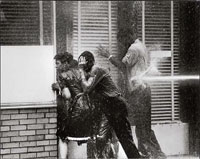
The scene depicted at the right is an old one, but a segment of New Jersey’s student population wants you to think that it’s from April, 2010 - and that Governor Chris Christie is wielding the hose.
Today, students in New Jersey public schools walked out of class to protest budget cuts:
Thousands of New Jersey high school students walked out of class Tuesday to protest budget cuts, a statewide event organized through text messages and social networking websites.
The anatomy of a protest was on full display at Englewood’s Dwight Morrow High School. It started with a small group of students who tested the waters Tuesday morning.
“Education should always be the first priority,” said junior Amber Diaz.
I’d argue that insisting on reform, which includes the defeat of bloated, unsustainable fiscal plans and the failing systems that perpetuate them, isn’t making education a lesser priority, but that argument tends to get lost when the NJEA and “for the children!” are on the other side.
What’s remarkable here is the truth behind this walkout: that not only was it misguided, but that its supporters - including the event’s organizer Michelle Ryan Lauto - aren’t all that interested in figuring out any real solutions to New Jersey’s education problems.
Derrell Bradford, Executive Director of Excellent Education for Everyone (E3) is an education reform warrior. I’m no shrinking violet, but he’s the best. If I had a child and could choose one person on the national education scene to advocate for him, I’d choose Bradford. He live-Tweeted the walkout in Newark with some salient observations:
- Students in Newark protesting budget cuts…not the terrible caliber of education they receive. Let’s get our eye on the ball folks.
- @ByronArnao Better than my view. Newark has 9 of the worst high schools in NJ. I wonder which one these kids go to http://twitpic.com/1ivmu8
- Newark student walkout just rolled past my window. Appx 40% of kids here fail exit exam…in one of America’s most expensive districts.
- Newark students protest budget cuts. Newark pays less than 10% of its school costs and has 20% of the state’s worst schools.
- Wonder if more seat time would be preferable to rallying for schools that are draining the life from our kids. Stop defending failure.
I agree with Bradford; the walkout misses the point. The protest doesn’t take into account that there are reforms that result in responsible budgeting and, believe it or not, better educational outcomes for students. One could also assume that eliminating instructional time - especially in Newark, which does an abysmal job of educating too many of its youth in even the most fundamental areas - doesn’t help achievement. Eventually Bradford got on with his day:
- At a school in Jersey City with kids learning, and not protesting. Imagine that. #edreform #njea
Amen, brother.
I took the policy discussion to Twitter myself; I was told by one New Jersey teacher that the walkout was a ‘good way to learn about the 60′s’ and by an NJ administrator that it was an ‘authentic edu experience.’
Reasons #13,984 and #13,985 why I didn’t go to ed school, but I digress.
So what of the protest’s organizer, Michelle Ryan Lauto, and her commitment to finding the best solution to a difficult problem? Mashable tells us how it went down:
“According to students who took part in the protest, it was largely organized via social networking efforts — texts, MySpace and, of course, the original Facebook Event. Lauto has been tweeting about the walkout all day, expressing her joy at the turnout and excitement about the barrage of interview requests she has received from the media. In fact, we’re currently waiting on comment from Lauto, who — last she e-mailed us — was preparing to meet a camera crew at her house.”
May God bless Lauto; the media already has.
Surely a graduate of an NJ public school, and now a college freshman, with the initiative to create a massive Facebook campaign resulting in the removal of thousands of students from class would be interested in open, intellectually honest debate about education - and her Tweets proved it:
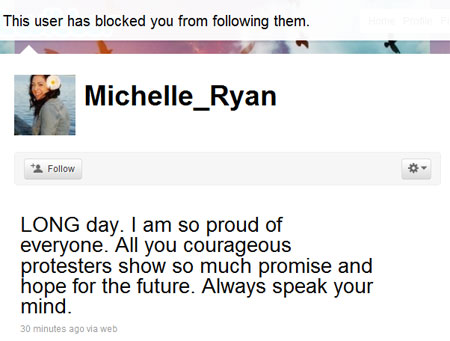
- LONG day. I am so proud of everyone. All you courageous protesters show so much promise and hope for the future. Always speak your mind.
I disagree with Michelle’s protest, but I’m on board with “Always speak your mind.” We need to discuss solutions to New Jersey’s problems now more than ever, and there are quite a few problems and solutions to consider in this mess. I Tweeted her:
- @Michelle_Ryan Since you’ve Tweeted “Always speak your mind,” I will - the NJ student walkout you organized was disgraceful. #njea #edreform
And that’s when this darling of political discourse - of civil disobedience, of courage, of ‘fight the power’ no matter how illogical or misguided - showed how committed she was to open debate:
Yipes. She’s learned a lot about political advocacy in less than a year at Pace; only engage on your terms, and if it doesn’t follow your narrative, shut’em up. Or run for the hills, whatever.
Such is the intellectual depth behind her protest - that standard youthful mantra, ‘I believe what I want to believe, I won’t be bothered by any arguments against it, and gosh-darnit, we’re entitled to whatever we want, NOW!’
Now, of course, Michelle is famous - a budding Alinskyite [actually, as an article said, an actress] who’s shown Governor Chris Christie the power of New Jersey’s youth. She gushed all day about interviews with CBS, the New York Times, CBS Radio, NJN, Associated Press… she’s a pro.
I’d paste those messages, but our darling Michelle has gone from blocking me to blocking everyone - she’s protected her Tweets. Sorry, folks!
Is she interested in any real dialogue about education reform in New Jersey? Not a chance. If your narrative doesn’t match hers, she doesn’t want any part of it. Something tells me a few thousand kids in New Jersey shared that philosophy today - and that the NJEA loved every minute of it.
After all, these are the same folks who think that New Jersey is about to be ruled by the next Pol Pot, that “A-hole” is spelled “C-H-R-I-S-T-I-E” and that you should “never trust a fat f—.”
They also just used thousands of New Jersey schoolkids, whether Michelle Ryan Lauto and her teenage hordes realize it or not.